
Cart
0
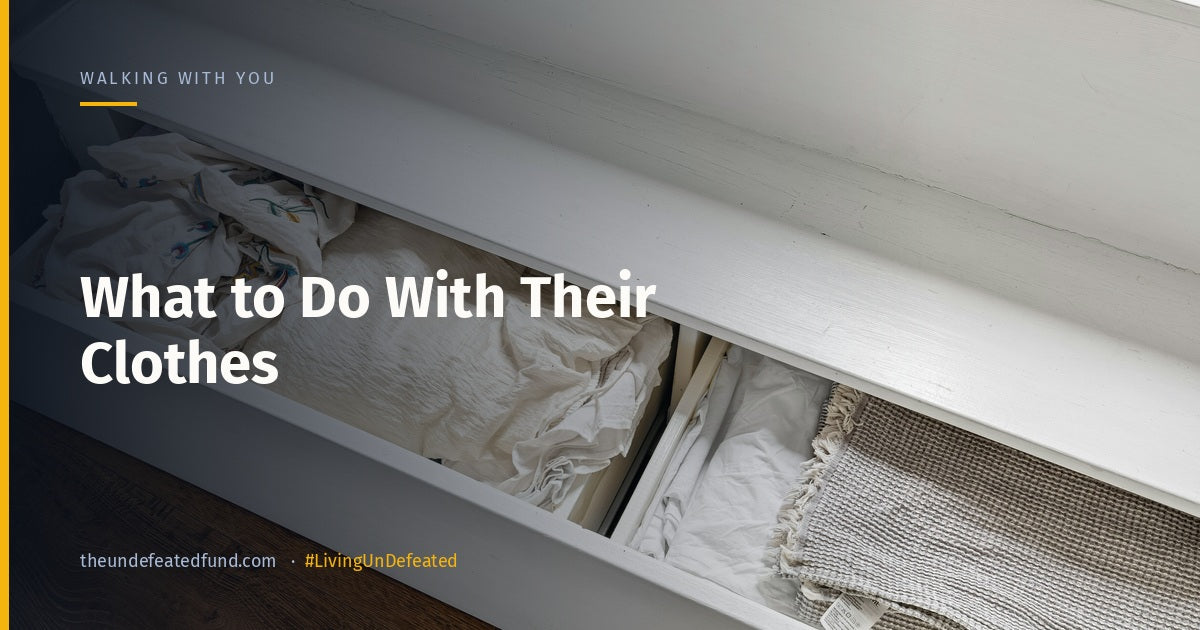
The drawer is still full. You know which drawer.
Maybe it isn’t a drawer. Maybe it’s a laundry basket nobody has touched, or a hook by the back door, or one shirt over the arm of a chair the whole house now walks around. Somewhere in your home there is fabric that belonged to your child, and it is carrying more weight than fabric was ever built to carry.
People have started asking what you’re going to do with it. Or they haven’t yet, and you can feel it coming.
Almost everything written about what to do with their clothes is written by people who have never stood in front of that drawer at two in the morning with a hand on the handle, not opening it. So here is the part that isn’t optional: there is no correct answer to this, and there is no deadline. Not six months. Not a year. Not ever, if that’s what you want.
Why is opening that drawer so much harder than it sounds?
Because clothes aren’t like photographs. A photograph is a picture of your child. A sweatshirt is a thing your child was inside of.
That difference isn’t sentimental. It’s physical, and philosophers Becky Millar and Louise Richardson named it in a 2023 paper in the Pacific Philosophical Quarterly. A smell produced by a person, they write, “unlike their look, feel or a sound they have made — is something that very plausibly they can quite literally leave behind them to be perceived when they are gone.”
A photograph shows you something that happened elsewhere. A smell is experienced as being in the room with you.
Which is why the drawer is not storage. It’s the last place in the house where your child is still, physically, present. Nobody opens that casually.
Is it all right to leave everything exactly where it is?
Yes.
Not “for now.” Not “until you’re ready.” Yes.
The idea that keeping a dead person’s belongings is unhealthy, and that clearing them out is the mature next step, is folk wisdom rather than evidence. Researchers spent thirty years on the opposite idea. In 1996 Dennis Klass, Phyllis Silverman and Steven Nickman published Continuing Bonds, which argued that people don’t heal by detaching from someone who died — they carry the relationship forward in a changed form.
In 2023, Hollie Hewson and colleagues reviewed that literature in Death Studies, including 79 studies from 319 screened, and found those ongoing bonds carry real adaptive potential — helping people rebuild meaning and hold on to who they are. The findings aren’t uniform, and the review doesn’t claim the same thing works for everyone. What it does say is that keeping a connection going is not a symptom.
So the shirt on the chair is not a problem to be solved. It can stay on the chair.
Is it all right to want it all gone by the weekend?
Yes.
Same word, same weight, and it needs saying just as plainly — because this is the answer people get shamed for.
Some people cannot be in a house with it. Some open the drawer once and know immediately, with total clarity, that they need the room back. Some find that every object is an ambush, and that a house full of ambushes is not survivable. That urgency isn’t coldness. It isn’t a failure to have loved them enough, and somebody will manage to imply that it is.
There are parents who packed everything within the week and have never once regretted it. There are parents who haven’t touched a thing in years and are equally at peace. Both of those people exist, and both are in every support group in the country.
Neither is the healthier answer. Anyone who tells you which one is — including people who love you, including people who have been bereaved themselves — is telling you what they would do, or what they did. That’s all it is.
What do people actually do with a child’s clothes?
Here is the practical range. It’s not in order of anything, and there’s no recommended option in it.
- Nothing. Leave it. This is a real choice and not the absence of one.
- Close the door. Keep the room or the drawer exactly as it is, but stop having to see it every day.
- Box it. Move it out of daily sight without deciding anything. Label the box, because in three years you won’t want to find it by opening it.
- Keep one thing, release the rest. A single shirt, the coat, the pajamas. For some people this is the version that works: one object carries it, and the volume stops being a weight.
- Give them to someone who needs clothes. A shelter, a hospital, a family you know. Some people need this to have happened; others find the idea unbearable. Both are common.
- Have something made. Quilts, cushion covers, bears and pillows get made from a child’s clothes. Worth knowing before you give anything away, because it can’t be done afterwards.
- Let someone wear them. A sibling, a cousin, a friend. Seeing them worn can be the best thing or the worst thing, and you may not know which until it happens.
One more thing, worth holding lightly. When Maile Jones, Elena Albanese and Jessika Boles interviewed 17 bereaved parents and family members for a 2023 study in Palliative Medicine, families described their child’s legacy almost entirely through who the child was and how they affected people — not through objects left behind. Small study, and not about clothes. But it speaks to the fear underneath all of this: that if the things go, the child goes. In that study, they didn’t.
What about the smell?
It fades, and nobody can tell you how long that takes. It depends on the fabric, how it’s stored, your own nose, and whether the garment was worn or washed before. Nobody warns you about this, and it is the part people are least prepared for.
You will find yourself doing things you would never say out loud. Rationing it. Opening the drawer only occasionally so as not to use it up. In her 2020 memoir The State of Disbelief, the psychotherapist Juliet Rosenfeld described sitting inside her late husband’s wardrobe and shutting the door so his smell could not escape: “If it was left open I shut it immediately. The smell would be wasted!” Her book is about losing a husband rather than a child, and the behavior it describes is one bereaved parents recognize instantly.
Here is the honest part. There’s no reliable figure for how long it takes, and anyone who offers you one is guessing.
It does fade. Worth saying plainly, because people discover it by accident — going back to the drawer on a bad night and finding the thing they went there for isn’t there any more. That’s its own loss, arriving long after everyone assumed the losing was finished, and it catches people completely unguarded.
Some practical things people do, offered as information, not instruction. Sealing one garment unwashed in a bag or box and not opening it, which preserves it longest at the cost of not having it. Keeping one to use and one to keep. Deciding that a particular thing will not be washed, and telling the rest of the house so it doesn’t go through a load of laundry by accident — which happens, and is devastating.
And for some people the smell is not a comfort at all. It is the single most distressing thing in the house, and they need it gone. That happens too, and it is not a defect.
What do people tend to regret?
We haven’t found reliable research on what bereaved parents regret here, and we’re not going to invent a figure to fill the gap.
What can be said without data is structural. An object given away usually can’t be got back. An object kept can still be given away later. The two decisions aren’t mirror images — one is reversible and one mostly isn’t.
That is not an argument for keeping everything. A house you can’t move through has its own cost, and relief is a legitimate outcome that people are rarely allowed to admit to. The asymmetry doesn’t tell you which choice is better. It only tells you they’re different kinds of choice, and that speed carries more consequence in one direction than the other.
What we have found to help is having somewhere to put the things you can’t decide about. A box is not a decision. It’s a way of not making one today, which is a perfectly respectable thing to do with a Tuesday.
What if a relative keeps pushing?
Someone will tell you that clearing the room is how you get better. Someone else will be appalled that you’d consider it. Occasionally these will be the same person in the same week.
Most pushing is about the pusher. Watching you stand still in it is unbearable for people who love you, and getting the room cleared makes them feel something is improving. Understanding that does not oblige you to cooperate with it.
Things people say, which you are welcome to borrow:
- “I’m not ready, and I’ll tell you when I am.” A complete sentence. It needs no justification, and adding one invites negotiation.
- “That worked for you. It isn’t working for me.”
- “You can help me by not asking about this again.”
- “If you touch anything in that room, we’re going to have a serious problem.” For the person who has already been told twice.
If the disagreement is with a partner, it’s harder, because you both live there and you’re both right. Two people in the same house can need opposite things from the same drawer. One arrangement that helps: nothing gets moved by one person alone, and either of you can stop a sorting session at any moment without giving a reason. That doesn’t resolve it. It stops it becoming the thing you fight about instead of the thing you’re grieving.
What if someone has already moved things?
This happens more than people admit, usually while the family is at the funeral, almost always by someone convinced they’re being kind.
If it’s recent, ask straight away where things went. Charity shops process donations quickly, and bags can sometimes be retrieved. Asking is not ungrateful, and you owe nobody an apology for wanting your child’s things back.
If it’s gone and can’t be recovered, that’s a real loss sitting inside a much larger one. You don’t have to be gracious about it. Whether you say anything to the person who did it is yours to decide, and there’s no version of that conversation anyone gets right.
Where else can you go with this?
Three places, all free, none selling anything.
The Compassionate Friends’ chapter locator — more than 600 chapters across the country, for families who lost a child at any age, from any cause. A room of people who have made this exact decision in every direction is worth more than any article, including this one.
The Dougy Center — free resources on how children grieve at different ages. Useful if a sibling wants to wear the shirt, or wants the room untouched, or wants something you didn’t expect.
Bereaved Parents of the USA — peer support, with strong material for the newly bereaved.
The drawer
It doesn’t have to be opened today. It doesn’t have to be opened this year.
And if you open it tonight and have the whole thing empty before it gets light, nobody here is going to think you loved them any less.
Both are things parents who have stood exactly where you’re standing have done. That is the entire honest summary of what anyone knows about this.
Save this for the day you need it.


