
Cart
0
The ribbons came off overnight.
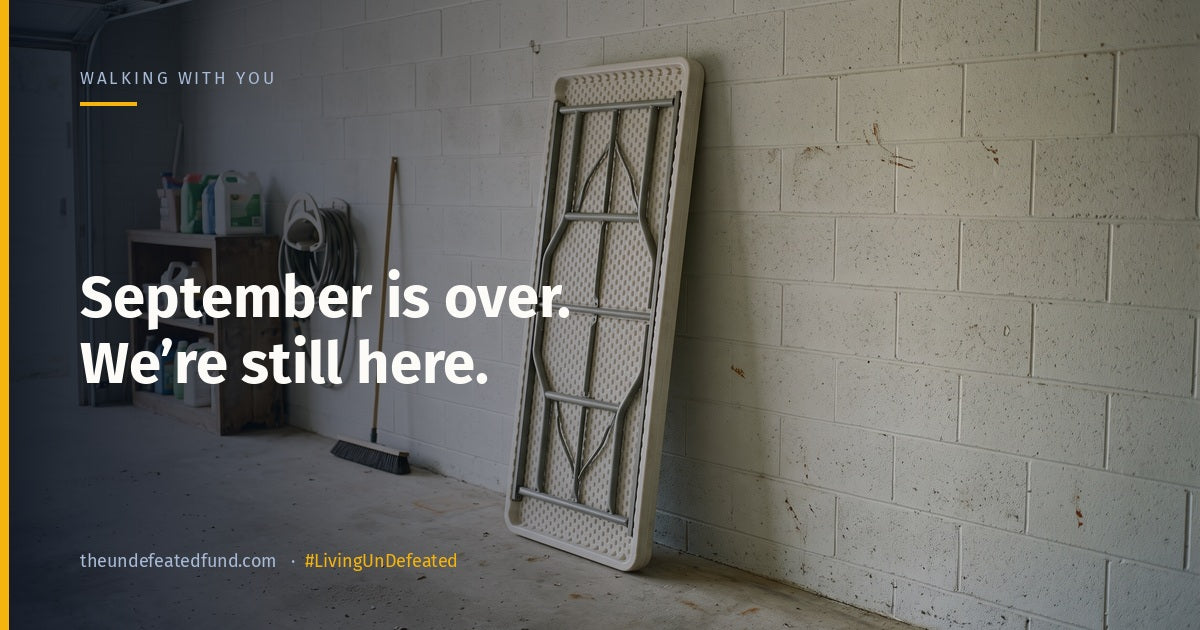
Not deliberately, and not by anyone unkind. Somebody's profile picture reverted to the beach photo. A company logo went back to its usual color at midnight. The 5K happened, the check was handed over, the banner came down off the fence at the high school. Somewhere there is a folding table in a garage that will not come out again until next September.
That is what happens on the first of October, every year. Childhood Cancer Awareness Month gets packed up.
And if you are the family, nothing was packed up at all. You woke up this morning into precisely the same life you went to sleep in. The month ended. The thing the month was about did not.
We are writing this today on purpose. Almost nobody in this sector publishes on October 1, because the campaign is over and the attention has moved. That is exactly why it seemed like the right morning to say the one thing an awareness month structurally cannot say.
We were not here only for the month.
If you are the family, today is just Thursday
There is a particular quiet to the first week of October, and people who have been through it recognize it immediately.
In September, the world briefly spoke your language. There were posts you didn't have to explain. There was a reason people thought about you. A cousin you hadn't heard from since spring sent a gold ribbon graphic and it landed better than she could have known.
Then the calendar turned, and the volume dropped back to where it usually sits.
If today feels worse than September did, that is not a failure of yours, and it does not mean anything has gone backwards. A month of company ending is its own small, real loss, sitting on top of the enormous one. You are allowed to have noticed.
And if today feels like nothing in particular — if September came and went and you barely registered it, because you are eleven weeks in and still mostly just getting through the hours — that is also not a failure. The month is a thing the world does. It is not an appointment you were supposed to keep.
There is no way to be doing this correctly. We will not pretend otherwise in order to give this page a tidier shape.
Why the calendar was never the thing
Recovery from grief is unrelated to the amount of time since the death. That is the finding, and it is why a lot of what gets said about time is wrong.
In 2008, researchers led by Catherine H. Rogers published a study in the Journal of Family Psychology following bereaved parents identified in the Wisconsin Longitudinal Study — 428 of them, compared against 428 parents of similar background who had not lost a child. They were assessed an average of 18.05 years after the death, when the parents were around 53 years old.
The bereaved parents reported more depressive symptoms, poorer well-being and more health problems than the comparison group. Eighteen years on.
But the line in that paper we think about most is a quieter one. Recovery from grief, the researchers found, was unrelated to the amount of time since the death (Rogers et al., Journal of Family Psychology, 2008).
Not slower than expected. Unrelated.
Which means the thing so many people are handed — give it a year, give it two, you'll turn a corner — has no evidence underneath it. Time passing is not the mechanism. A month on a calendar was never going to be the mechanism either.
We are not telling you that to take hope away. We are telling you because you may have spent September quietly measuring yourself against a schedule that does not exist, and you can put that particular weight down.
The same paper found that recovery was associated with having a sense of life purpose. We want to be careful with that sentence, because it is the researchers' finding and not an instruction, and it is not something anybody can hand you on a Thursday in October. It is the reason this Fund exists in the shape it does. It is not a task we are assigning you today.
This is not a gap you imagined
If it has felt like support simply stopped being available after the first few weeks, you are not misreading your own life.
In a 2020 discussion paper for the National Academy of Medicine, Joyal Mulheron and Dr. Sharon K. Inouye wrote:
"Bereavement care in the United States is broken. The lack of consistent, high-quality bereavement care for Americans constitutes an invisible public health crisis."
That is the National Academy of Medicine, not a support group's newsletter. The casseroles stopping was not personal. There is no system behind the casseroles.
Knowing that changes very little about today. But it does move the explanation off you, which is worth something at 2am, when the available explanations tend to be unkind ones.
The numbers don't have a month either
The American Cancer Society estimates that about 9,680 children in the United States ages 0 to 14 will be diagnosed with cancer in 2026 (Key Statistics for Childhood Cancers, 2026). The National Cancer Institute's most recent estimate covers a broader age band: 14,910 children and adolescents ages 0 to 19 diagnosed, and 1,590 deaths, for 2024 (NCI, Cancer in Children and Adolescents, updated August 27, 2024). We keep our statistics sourced and dated, and we keep them few.
Cancer is the leading disease-related cause of death among children and adolescents in the United States (American Cancer Society, Cancer Facts & Figures 2026). The National Cancer Institute puts the same fact in its own words — "the leading cause of death by disease after infancy among children in the United States" (NCI, Cancer in Children and Adolescents, updated August 27, 2024). Either way, it is narrower than the sentence that circulates every September, which quietly drops the word disease and turns it into something it is not. We have said so before and we will keep saying so.
And the genuinely good news, which is real: about 85% of children diagnosed with cancer now survive five years or more, up from roughly 58% in the mid-1970s (American Cancer Society, Key Statistics for Childhood Cancers, 2026).
None of those numbers went down yesterday at midnight. Diagnoses happen in October. They happen on Christmas Eve. The families who received one last week are eight days into something that has no awareness month around it at all.
If you changed your profile picture in September
There is something to do that isn't a hashtag, and it is smaller than a 5K and works better. This part is for the other person reading — the one who posted, meant it, and is now wondering.
In October, this month, right now: pick one family you actually know and put a recurring reminder in your phone. Not for the anniversary — for an ordinary Tuesday. Then send a text that does not ask them to do anything. Thinking about Sam today beats let me know if you need anything, because the second one makes the grieving person do the work of asking. Use the child's name. People are terrified of using the child's name, and almost every bereaved parent we have ever heard from wants to hear it.
In November: Children's Grief Awareness Day falls on Thursday, November 19, 2026 — the third Thursday in November, created by the Highmark Caring Place in 2008. It sits the week before Thanksgiving, which is not an accident. If there are grieving children in your school, your team or your family, that is a real hook for asking the adults around them what would actually help before the holidays arrive.
In February: International Childhood Cancer Day is February 15, coordinated by Childhood Cancer International and the International Society of Paediatric Oncology. It is four and a half months from now, it is the furthest thing from anyone's mind, and putting it in your calendar today is the single clearest signal that you were not only here for September.
And in any month: learn the date. Every family has one or two days the rest of the world walks straight past. If you are close enough to know it, know it, and be reachable on it.
Where to go when you need people
Four things we would point to, and why.
The Compassionate Friends chapter meeting locator — peer support for families after the death of a child at any age, from any cause, with chapters across the country. We link the locator rather than the homepage because the useful thing is finding the room nearest you. Their national office number is on that page.
The American Childhood Cancer Organization's bereavement page — free digital guides for parents whose child died of cancer, and free moderated email support lists including one for parents in exactly that position. ACCO is a cause The Undefeated Fund contributes to, and we want that said plainly before we point you anywhere of theirs. We link their help, never their donation page.
Children's Grief Awareness Day — created by the Highmark Caring Place in 2008. If you have surviving children, or you teach them, their materials are built for the adults standing next to a grieving kid. We name it here rather than link it: it is not yet in our vetted resource library, and we don't send a grieving reader to a domain we haven't screened.
And if you want the numbers themselves rather than anyone's summary of them, the National Cancer Institute's fact sheet is the primary source we use, and we would rather you check us than take our word.
If you want more on why we are careful with the figures that circulate every September, we wrote that out separately in the childhood cancer statistics we won't repeat.
What today is actually for
An awareness month is a good thing. It raises money that becomes research, and research is most of the reason that 85% figure looks the way it does now instead of the way it looked in 1975. We are not sour about September and we are not going to be. Anyone who wore a gold ribbon last month did something real.
It is just that September ends, and February 15 is a long way off, and in between there are about twenty ordinary Thursdays.
Those are the days this is for.
We will be here in the second week of November, and in January when nobody is posting about any of this, and next year on the first of October, which will feel much like today. Not because it is a campaign. Because there is no month in which this stops being true.
You don't have to do anything with this page today. It will keep.
Save this for the day you need it.
If you or someone you love is in crisis, or having thoughts of suicide, help is available now. Call or text 988 — the 988 Suicide & Crisis Lifeline, free and confidential, 24 hours a day, anywhere in the US. You can also text HOME to 741741 to reach the Crisis Text Line.


